
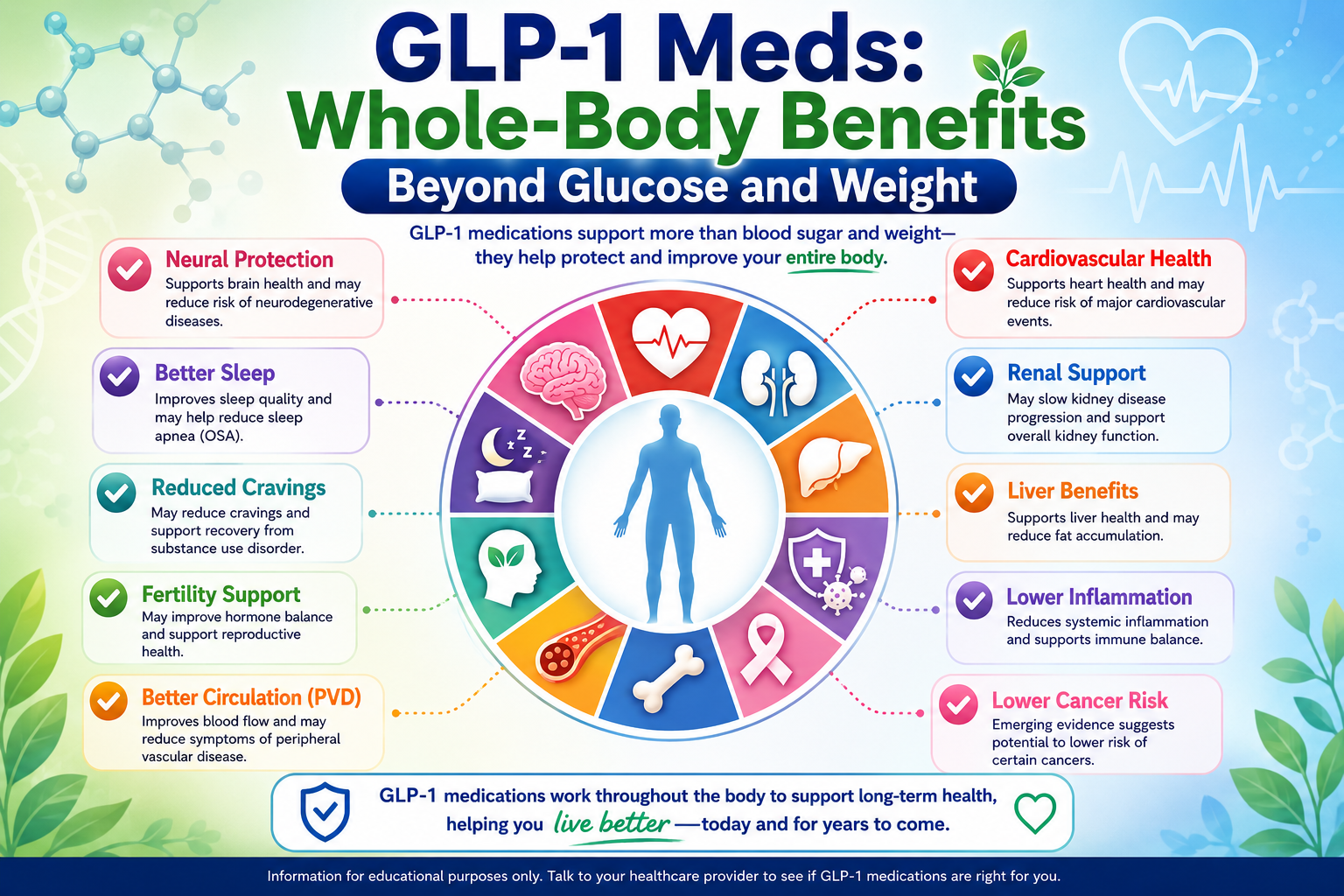
The Whole‑Body Benefits of GLP‑1 Medications
GLP‑1 medications offer benefits far beyond blood sugar and weight. They support many organs and systems throughout the body.
The Whole‑Body Benefits of GLP‑1 Medications
GLP‑1 medications do far more than help with blood sugar control and weight loss. Research — including multiple FDA‑approved indications — shows that these medicines support many organs and systems throughout the body. Below is a patient‑friendly overview of the benefits and the science behind them. If you’re more of a visual learner and prefer short videos, feel free to explore our video gallery.
1. Heart Health (Cardiovascular Protection)
GLP‑1 medications have been shown to lower the risk of major heart problems by 13-20%, including heart attack, stroke, and cardiovascular death. They also reduce hospitalizations for heart failure by 14%. These benefits come from improved blood vessel function, healthier blood flow, and modest blood pressure reduction. (1,2,3)
2. Kidney Health (Renal Protection)
GLP‑1 medications help slow the progression of chronic kidney disease, reduce protein in the urine, and protect the kidneys’ filtering ability. In the FLOW study, semaglutide lowered the risk of kidney complications by 24%. (1,4,6)
3. Liver Health (Fatty Liver Disease / MASH)
Semaglutide is now FDA‑approved for non‑cirrhotic metabolic liver disease. In the ESSENCE trial:
62.9% of patients had resolution of liver inflammation
36.8% showed improvement in liver fibrosis
GLP‑1 medications also reduce liver fat, swelling, and inflammation. (7, 8, 10)
4. Obstructive Sleep Apnea (OSA)
Tirzepatide is now FDA‑approved for moderate‑to‑severe OSA in adults with obesity. It reduced breathing pauses by 20–24 events per hour, and about half of patients improved enough that they no longer needed positive airway pressure therapy. (11)
5. Substance Use Disorders (SUD)
Early research suggests GLP‑1 medications may help reduce cravings and substance‑related behaviors. Large population studies show lower risks of alcohol, nicotine, opioid, cannabis, and cocaine‑related hospitalizations among GLP‑1 users by 36%. Clinical trials are ongoing. (12, 13, 14, 15)
6. Brain Health (Neuroprotection)
Long‑term GLP‑1 use has been associated with lower rates of dementia by 37 - 56%, Parkinson disease by 30%, and multiple sclerosis. Animal studies show reduced inflammation in the brain, healthier nerve cells, and improved cellular energy. Clinical trials are underway, but no official indication exists yet. (16, 17, 18)
7. Anti‑Inflammatory Effects
GLP‑1 medications lower several inflammation markers in the blood, including CRP and TNF‑α. They also increase adiponectin — a hormone that helps reduce inflammation, improve insulin sensitivity, and support heart health. (2, 19)
8. Cancer Risk
Most studies show GLP‑1 medications do not increase the risk of thyroid, pancreatic, breast, or kidney cancer. A large meta‑analysis of nearly 4 million people found a 30% lower risk of obesity‑related cancers, including liver, colon, pancreatic, endometrial, esophageal, gallbladder, and ovarian cancers. (21-26)
Important note: GLP‑1 medications should not be used by individuals with MEN2 syndrome or a family history of medullary thyroid cancer, due to a specific FDA warning. More on this in our article “Thyroid and GLP1 meds”
9. Fertility and PMOS (Polyendocrine Metabolic Ovarian Syndrome)
GLP‑1 medications can improve ovulation, menstrual regularity, and natural conception rates in women with PMOS by 72%. Studies show better pregnancy rates, including significantly higher IVF success in some trials.
Important: GLP‑1 medications are not approved during pregnancy, and manufacturers recommend stopping them 2 months before trying to conceive. Because fertility may improve, contraception counseling is important. (28, 30-32)
10. Healthy Aging and Cellular Protection
In animal studies, GLP‑1 medications help cells function more youthfully by reducing stress, improving mitochondrial energy, and slowing cellular aging. Older animals showed body‑wide “age‑counteracting” effects, even at low doses.
Human studies show lower overall mortality among GLP‑1 users by 77% in 5 years, though it’s unclear whether this is due to anti‑aging effects or the combined benefits across organs. (33, 34, 36)
11. Bone Health
Research shows improvements in bone mineral density in the spine, hip, and femoral neck, along with healthier bone turnover markers. GLP‑1 medications do not appear to increase fracture risk. Monitoring may be helpful for individuals experiencing rapid weight loss. (37-40)
12. Peripheral Artery Disease (PAD)
GLP‑1 medications reduce cardiovascular events by 14% and mortality by 33% in people with PAD. In the STRIDE trial, semaglutide improved walking distance in patients with PAD and type 2 diabetes — similar to the benefits of cilostazol, a common PAD medication. (41–44)
The Bottom Line
GLP‑1 medications are no longer just “diabetes drugs” or “weight‑loss medications.” They are whole‑body therapies with benefits across the heart, kidneys, liver, brain, metabolism, sleep, fertility, inflammation, and more.
If you’re interested in GLP‑1 therapy and want an affordable, fully virtual program with no office visits required, you can get more from our Weight Management Program. And remember — you won’t be doing this alone. We’re with you from start to finish
__________________________________________
References:
1. GLP-1 Receptor Agonists.
The New England Journal of Medicine. 2026. Rosen CJ, Ingelfinger JR.
2. Cardiovascular Risk Reduction With GLP-1 RA Drugs.
Circulation. 2026. Pigeyre M, Gerstein HC.
Journal of the American College of Cardiology. 2025. Galli M, Benenati S, Laudani C, et al. Recent SR
4. Potential Kidney Protective Effects of Glucagon-Like Peptide-1 Receptor Agonists.
Nephrology. 2024. Trevella P, Ekinci EI, MacIsaac RJ. Review
Lancet. 2026. Nauck MA, Tuttle KR, Tschöp MH, Blüher M. Recent Review
American Journal of Kidney Diseases: The Official Journal of the National Kidney Foundation. 2025. Chen JY, Hsu TW, Liu JH, et al.SR
7. FDA Orange Book.
FDA Orange Book. 2026.
Diabetes Care. 2026. American Diabetes Association Professional Practice Committee for Diabetes*. Recent Guideline
9. Metabolic Dysfunction–Associated Steatotic Liver Disease.
The New England Journal of Medicine. 2025. Targher G, Valenti L, Byrne CD. Recent Review
The Journal of Clinical Endocrinology and Metabolism. 2025. Wang Y, Zhou Y, Wang Z, et al. Recent
Diabetes, Obesity & Metabolism. 2026. Nowak K, Dziewierz A, Łupina K, Szarpak Ł, Siudak Z. Recent Opinion
BMJ. 2026. Cai M, Choi T, Xie Y, Al-Aly Z. Recent
13. Repurposing Semaglutide and Liraglutide for Alcohol Use Disorder.
JAMA Psychiatry. 2025. Lähteenvuo M, Tiihonen J, Solismaa A, et al. Observational
Biological Psychiatry. 2026. Klausen MK, Fink-Jensen A. Recent Review
15. Prospects of GLP-1 Therapies for Addiction and Mental Health Comorbidities—Quo Vadis?.
JAMA Psychiatry. 2026. Farokhnia M, Leggio L. Recent Review
16. The Promise of GLP-1 Receptor Agonists for Neurodegenerative Diseases.
The Journal of Clinical Investigation. 2026. Athauda D, Greig NH, Meissner WG, Foltynie T, Gandhi S. Recent Review
Diabetes, Obesity & Metabolism. 2026. Spezani R, Mandarim-de-Lacerda CA. Recent Review
Frontiers in Immunology. 2026. Yang M, Liang Z. Recent Review
Diabetes, Obesity & Metabolism. 2021. Bray JJH, Foster-Davies H, Salem A, et al.SR
Diabetes, Obesity & Metabolism. 2024. Kunutsor SK, Zaccardi F, Balasubramanian VG, et al.SR
Annals of Internal Medicine. 2025. Ko A, Chang YC, Bahar F, et al. Recent Review
Diabetes Research and Clinical Practice. 2026. Ateiwi YA, Mahmood R, Wong HJ, et al. Recent SR
Frontiers in Oncology. 2026. Eze ED, Ntakirutimana L, Terkimbi SD, et al. Recent SR
24. Glucagon-Like Peptide 1 Receptor Agonists and Cancer Risk: The Good, the Bad and the Unknown.
Nature Reviews. Clinical Oncology. 2026. Mannucci E, Dicembrini I. Recent Review
The Journal of Clinical Investigation. 2025. Valencia-Rincón E, Rai R, Chandra V, Wellberg EA. Recent Review
EClinicalMedicine. 2026. Irons EE, Pfeil KA, Perez JA, van Besien K. Recent Observational
27. GLP ‐1 receptor agonists and the risk for cancer: A meta‐analysis of randomized controlled trials.
Diabetes, Obesity & Metabolism. 2025. Silverii GA, Marinelli C, Bettarini C, et al.SR
Diabetes, Obesity & Metabolism. 2026. Lu YT, Chang PH, Chen HJ, et al. Recent SR
Diabetes, Obesity & Metabolism. 2026. Ozbek L, Shah E, Al-Shiab R, et al. Recent SR
30. The Role of Glucagon-Like Peptide-1 in Reproduction: From Physiology to Therapeutic Perspective.
Human Reproduction Update. 2019. Jensterle M, Janez A, Fliers E, et al. Review
The Journal of Clinical Endocrinology and Metabolism. 2025. Wyckoff JA, Lapolla A, Asias-Dinh BD, et al. Guideline
Journal of Clinical Medicine. 2026. Abedi MM, Patni MM, Shajahan ANB, et al.
Journal of the American College of Cardiology. 2023. Forman DE, Kuchel GA, Newman JC, et al.
34. Body-Wide Multi-Omic Counteraction of Aging With GLP-1R Agonism.
Cell Metabolism. 2025. Huang J, Kwok AJ, Li JCY, et al.
Diabetes, Obesity & Metabolism. 2024. Huang YN, Liao WL, Huang JY, et al.
Metabolism: Clinical and Experimental. 2026. Li M, Xu S, Cai H, Xiao J, Qin Y.
37. Impact of GLP-1 Receptor Agonists on Bone Metabolism.
The Journal of Clinical Endocrinology and Metabolism. 2026. Vadini V, Duan D, Moseley KF.
Acta Diabetologica. 2025. Tan Y, Liu S, Tang Q.
39. Glucagon-Like Peptide 1 Receptor Agonist Use and Vertebral Fracture Risk in Type 2 Diabetes.
JAMA Surgery. 2025. Khor WT, Chi KY, Lin HM, Chang Y.
Endocrine. 2025. Al Refaie A, Baldassini L, Mondillo C, et al.
The American Journal of Cardiology. 2025. Shuja SH, Shuja MH, Shaukat A, et al.
Journal of Vascular Surgery. 2025. Go CC, Annie F, Drabish K, Eslami MH.
Lancet. 2025. Bonaca MP, Catarig AM, Houlind K, et al. RCT
44. Peripheral Artery Disease in the Legs.
The New England Journal of Medicine. 2026. McDermott MM.